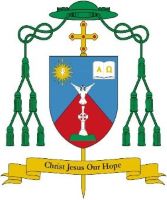
Bishop Niall Coll’s homily for the 125th Anniversary of the Dedication of the Cathedral of St Eunan and St Columba, 14 June 2026
Is lúcháir mór dúinn bheith le chéile anseo inniu agus muid ag ceiliúradh céad is fiche cúig bliana ó coisriceadh ardeaglais iontach Naomh Adhamhnán agus Naomh Colm Cille.
It is a great joy to gather here today as we celebrate the 125th anniversary of the dedication of this magnificent cathedral of St Eunan and St Columba. This is not simply the anniversary of a building. It is the celebration of a living story. A story of faith, perseverance and hope.
When the Penal Laws began to relax in the late 18th century, the Catholic people of Ireland slowly regained the freedom to worship openly. And with that freedom came a deep desire – not just to practise the faith, but to express it visibly and beautifully.
Here in Letterkenny, in impoverished circumstances that journey began humbly. Canon Maguire’s A History of the Diocese of Raphoe (1920) notes that around 1820, Fr James Gallagher built the first church on this site, later completed by Bishop McGettigan.
But the dream of something more remained – a true cathedral, the central church of the diocese, the home of the bishop’s chair – the cathedra – the symbol of his mission and authority.
That vision found its champion in Bishop Patrick O’Donnell. Despite the poverty of Donegal, he pressed ahead. Priests travelled far – to America, to Canada, to England and Scotland – seeking support from Donegal and Irish emigrants in general who had not forgotten family and home.
And so, in 1891, the foundation stone was laid. Slowly, faithfully, this cathedral rose – stone by stone – from the freestone, a type of sandstone found in Mountcharles. And in June 1901, it was dedicated, amid great celebration – Letterkenny was festooned with banners and flags, it was filled with colour, with delight, with joy and with faith.
And what rose here was not simply a church. It was something more. It is no exaggeration to say that this cathedral ever since has become for the Catholic people here the defining feature of the cultural and spiritual landscape of Letterkenny and the whole diocese.
Its spire, rising high above the town, does more than shape the skyline – in large measure it shapes its identity. For generations, life in Letterkenny has taken its bearings from this place. The sound of its bells, the rhythm of its liturgies, the beauty of its music, the great moments of joy and sorrow – baptisms, marriages and funerals – marked within these walls. Here, faith has formed a people – and that faith, in turn, has shaped a culture.
Think of the craftsmanship, to give but two examples: both the altar rails and the pulpit from which God’s word is proclaimed are the artistry of the Pearse workshop (a noted family in the history of our nation). And that is to say nothing about the marvellous paintings and statues.
This is not accidental beauty. It is the fruit of sacrifice – a people wanting to give their very best to God. Long before anyone spoke of heritage or tourism, this cathedral was already a cultural gem – where faith, art, music and a living sense of community meet in a way that is unique and, in many ways, unsurpassed in this region.
And perhaps, quietly, it says something more. In a time when faith is sometimes spoken of as fading, or belonging to the past, buildings like this tell another story. They do so quietly but firmly. They remind us that faith is not a passing fashion. It endures. It takes root. It leaves something lasting behind. Generations come and go. Trends rise and fall. But this cathedral remains. Still drawing people, still inviting prayer, still lifting hearts, still pointing beyond itself to God.
Not as a relic of what once was – but as a witness to what still is and a harbinger of what is to come. This is not a museum. It lives. Every day, people come here – for Mass, for prayer, for silence.
For 125 years, prayer has risen from this place. For 125 years, music has lifted hearts. For 125 years, this has been a place of encounter – with God … and with one another in faith, hope and love … clergy and people together.
And we are reminded, as we enter the cathedral, by those words over the main doors: ‘Ma thig fear ar bith tríomsa isteach sábhálfar é.’ … “By me, if anyone enters, he shall be saved.” Truly, Christ is the true foundation of all of this.
And that brings us to the Gospel today. We are told that Jesus, seeing the crowds, “felt sorry for them because they were harassed and dejected, like sheep without a shepherd.”
My friends, that compassion of Christ is the reason this cathedral was built. Not simply to stand – but to serve. Not simply to inspire – but to touch hearts and lives. It was built so that people might know they are not alone. That they are seen. That they are loved. And that in Christ, they can find their way.
And Christ says: “The harvest is rich, but the labourers are few.” Then he sends his disciples out to proclaim the Kingdom: That mission has echoed here for 125 years. And today – it is entrusted anew to us.
Only this past week, Pope Leo XIV stood in Barcelona and blessed the newly completed Tower of Jesus Christ in the Sagrada Familia Basilica – a great spire rising over that city, pointing people to Christ. It is a reminder that in every generation, faith seeks expression – in beauty, in stone, in something that endures.
Yes – beautiful churches matter. They lift the heart. They speak poignantly and silently of God. They exist for a purpose – to draw people to Christ … and to send disciples out.
And so today, we give thanks. But we also ask: What about the next 125 years? The answer does not depend only on this building. It depends on us. We are called to be the living cathedral – living stones Bbuilt into a spiritual house. To bring compassion where there is suffering. To bring hope where there is discouragement. To bring faith to those who are searching. To give freely what we ourselves have received.
My friends, we can be rightly proud of this extraordinary cathedral – its beauty, its history, its place at the very heart of our town and diocese. But even more, we are called to continue what it stands for. So that long into the future, this place will remain not just the heart of this town – but a living sign of Christ’s presence among his people.
A Mhuire, a Mháthair na hEaglaise, guigh orainne. A Adhamhnáin, a Cholmcille, a Bhríd guigí orainn. Amen.